
Artificial intelligence seems to be everywhere. It has moved into politics, economic strategy, financial decisions and everyday work. For many people, AI first appears as a practical tool: ChatGPT helping to structure ideas, draft text, write code or support research. But beyond the initial and personal use of large language models, the more decisive transformation is beginning to take place in industrial processes, production chains, automation and manufacturing. In the current phase of AI roll-out, we are beginning to see where it can create value, where it requires new infrastructure and regulation, and where it can increase dependencies.
According to a recent market study conducted by the Strand Partners research team commissioned by Amazon Web Services, AI adoption in Germany is on the rise, too: 63 per cent of companies are using AI, up from 53 per cent the previous year. However, only 15 percent of companies using AI have actually implemented truly transformative use cases. Yet the next phase of AI adoption offers unique opportunities, particularly for Germany, given its strong industrial base, supported by innovative small and medium-sized enterprises. Agent-based systems, advanced automation, robotics (programmable machines capable of performing physical tasks autonomously or semi-autonomously), and physical AI (systems that can perceive, interpret, and interact with the real world via sensors) – this next-generation AI drastically shortens innovation cycles in industrial value creation. This poses new challenges for the German manufacturing sector in particular, as global competition is accelerating.
From Everyday AI to Industrial AI
Germany could accelerate progress on this basis, say the market researchers. With its strong industrial base, engineering expertise and advanced manufacturing capabilities, the country is well positioned to take a leading role in industrial and physical AI. But there remains a gap between potential and actual adoption. If the pace does not accelerate, too many companies will remain stuck at basic use cases, and the macroeconomic potential of AI will remain untapped.
Germany is thus at a turning point. This is why gatherings such as GITEX AI Europe, which recently took place over two days in Berlin, matter. They are almost a strategic necessity, because AI transformation is about more than technical development. Technology alone does not create transformation. Institutions, investors, governments, engineers, founders, analysts and communicators need to meet, test ideas and identify where cooperation is possible. Because AI is not only a new technology. It is also an economic, cultural and geopolitical phenomenon, not to say an issue of power. The question is who builds AI models, who controls the infrastructure behind them, who benefits from them and how societies can integrate them responsibly.
GITEX itself has a long history. Originally launched in Dubai in 1981 as the Gulf Computer Exhibition, it has grown from a regional computer fair into one of the world’s most visible technology and startup platforms. The European edition, hosted in Berlin, brings this global technology network into the European context. After the first Berlin edition last year, GITEX AI Europe 2026 built on that foundation and positioned Berlin as a meeting point for Europe’s AI, startup, investment and digital sovereignty debate.
In this year, the forum focused not only on artificial intelligence and its regulation, but also on cybersecurity, cloud computing, fintech, quantum technologies and industrial innovation. The timing is urgent: Germany, and many European countries, need to move quickly from theoretical debate to concrete industrial application. That is why the primary themes of this GITEX were digital sovereignty, infrastructure, scaling capacity and a new wave of innovation investment.
For Berlin, this matters in particular. The city is already known for its startup culture, international talent and creative technology scene. GITEX AI Europe adds another layer: it connects Berlin with a global event architecture that reaches far beyond Germany. It also reflects a larger question: can Europe translate its scientific excellence, industrial strength, regulatory experience and engineering talent into global AI competitiveness?
Europe’s Strategic Weak Points: Energy, Infrastructure, Fragmentation and Speed
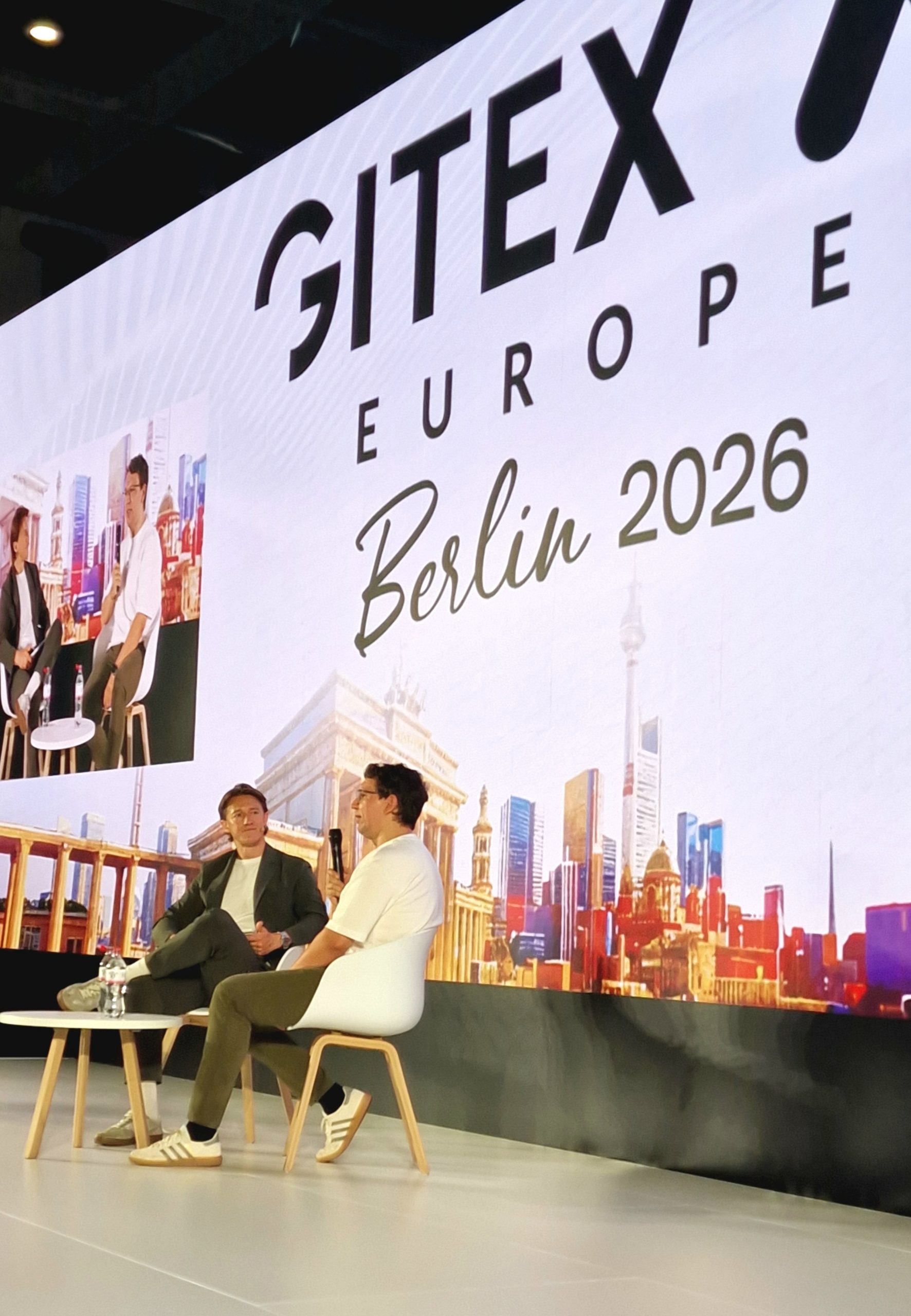
According to Stefan Mesken, DeepL, one of Germany’s most visible AI startups, founded in Cologne, Europe’s AI advantage depends on building intelligence infrastructure that can compete globally. Mesken’s central point in a panel moderated by Matt Smith, MC and host of GITEX Europe 2026, was that Europe does not lack ideas. Talent is here. Data is here. But the infrastructure remains weak. AI, in his view, is not only a software issue, but an industrial process.
This argument deserves attention. In public debate, AI is often described through applications: chatbots, image generators, productivity tools or automation software. But at the strategic level, AI depends on compute power, energy supply, data centres, cloud systems, chips, skilled labour and capital. Without these foundations, even strong ideas and the best researchers cannot scale globally.
The same concern appeared in the panel on digital sovereignty as a European choice. The questions are widely known and difficult to answer conclusively: Can Europe be optimistic? Are European companies strong enough to compete globally? Can fragmentation be overcome? What instruments does Europe have to protect its own capabilities while remaining open to international cooperation?
Mike Butcher, Pathfounders, UK, and former Editor-at-large at TechCrunch, pointed to two weaknesses that repeatedly appear in Europe’s digital debate: energy and fragmentation. Competing in compute power, AI factories and data centres means competing in energy availability. More AI capacity means more power demand. At the same time, Europe faces fragmentation across national systems, regulatory approaches, procurement structures and digital solutions. Germany itself often reflects this fragmentation internally, with complex administrative processes and persistent red tape.
Berlin and Europe’s AI Question
This is where the AI debate becomes geopolitical. Digital sovereignty is not only about having European software. It is about the ability to act independently in critical technological layers: cloud infrastructure, data control, cybersecurity, industrial platforms, investment capacity, public procurement and strategic dependencies, including possible external “kill switch” risks in global technology supply chains.
The urgency was more than visible in Berlin. According to views expressed during the event, Europe may have only a narrow window – perhaps just two years – to strengthen its position against the United States and China in key AI capabilities. The question is what instruments the bloc has to defend and develop its technological power and sovereignty.
Regulation is one instrument. The AI Act gives Europe a framework for trusted AI, but regulation alone will not create global champions. Public and private capital are equally important. The Scaleup Europe Fund, stronger venture financing, targeted procurement and better support for AI deployment in industry are necessary if European startups are to grow into global companies rather than relocate or be acquired too early.
However, Berlin is a good place for discussions like this. It is still unfinished in the best sense: a city where systems, cultures and ideas meet. GITEX AI Europe used this setting to offer a concentrated view on emerging technologies and industrial software opportunities, connecting the debate to wider issues of competitiveness and sovereignty.
The larger European question remains: Can Europe move fast enough, invest boldly enough, to turn strategic urgency into operational capacity?
Picture: Talk with Stefan Mesken, Chief Scientist at DeepL, moderated by Matt Smith, MC and GITEX Europe Host