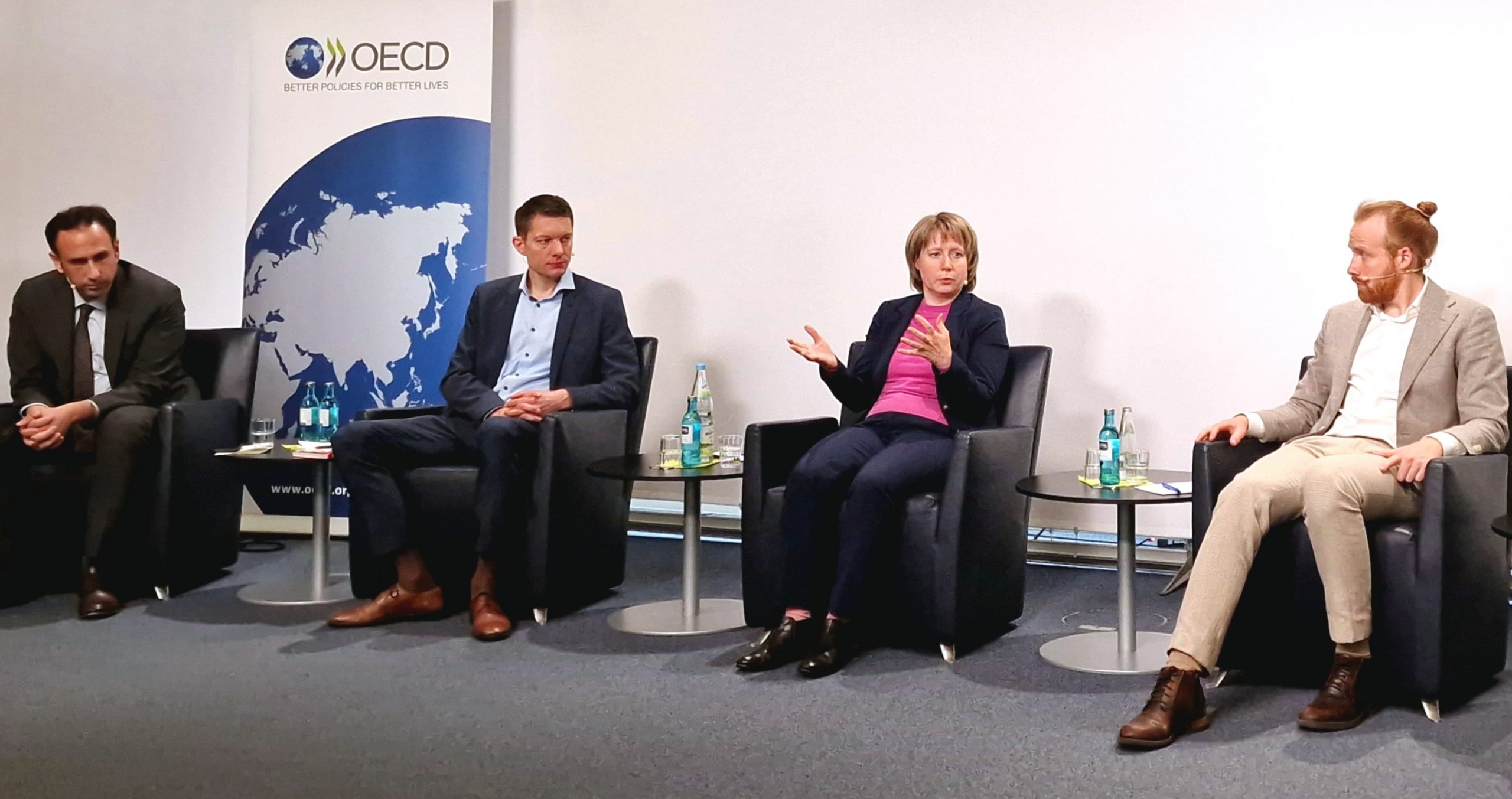
Today, I attended the 5th DIW-OECD Industrial Strategy Dialogue on “Industry Decarbonisation in Times of Energy Crises” at DIW Berlin. The discussion made one thing very clear: industrial transformation is not only a technological challenge – it is above all a strategic, financial and political one.
The event featured a presentation by Deger Saygin from the OECD, followed by a panel discussion with:
• Abdurrahim Durmuş, Türkiye’s Ministry of Environment, Urbanization and Climate Change
• Franziska Holz, Energy, Transportation, Environment Department at DIW Berlin
• Lutz Morgenstern, Federal Ministry for the Environment, Climate Action, Nature Conservation and Nuclear Safety (BMUKN)
• Yannik Sparrer, German Steel Association,
moderated by Nicola Brandt, Head of the OECD Berlin Centre.
A key takeaway for me was that industrial decarbonisation requires two parallel conditions:
– On the political side, governments must create stable and reliable framework conditions – including regulatory certainty, infrastructure development, targeted incentives, and long-term industrial policy.
– On the corporate side, companies need robust transformation strategies with realistic financing structures before industrial projects can become commercially viable.
This challenge becomes especially visible in large-scale green hydrogen projects. A practical example is the Hyphen Green Hydrogen Project in Namibia, which I analysed recently after my visit to Namibia earlier this year.
The project aims to produce green hydrogen for global export markets, particularly Europe and Germany. Yet despite its strategic importance, the project illustrates how difficult industrial transformation can be in practice. The challenges are multidimensional:
• social and political questions regarding local and indigenous communities
• major infrastructure requirements, including the expansion of Lüderitz port facilities
• costly transport and conversion infrastructure for hydrogen derivatives
• and the enormous logistical challenge of shipping energy products roughly 10,000 kilometres to Europe
But the most critical issue remains demand certainty.
Green hydrogen projects ultimately depend on the emergence of viable industrial demand in importing countries, for example in sectors such as green steel production, where green iron must first be produced using green hydrogen. Without predictable markets and long-term purchase commitments, financing such projects remains extremely difficult. This aligns with broader research on industrial decarbonisation and hydrogen transformation pathways, which repeatedly highlights that stable policy frameworks, infrastructure investment, and demand-side incentives are essential for scaling green industrial ecosystems.
To me, today’s dialogue confirmed that industrial transformation is not simply about financing individual projects. It is about building reliable ecosystems:
smart regulation, credible long-term targets, energy security, resilient business models, and coordinated industrial policy capable of supporting both digital and green transformation.
In this context, the proposed EU Industrial Accelerator Act – presented by the European Commission in March 2026 – could become an important step toward accelerating industrial decarbonisation and strengthening Europe’s industrial competitiveness.
Picture: DIW-OECD Industrial Strategy Dialogue “Industry Decarbonisation in Times of Energy Crises” | Tuesday, 12 May 2026, DIW Berlin.